
Working across borders does not mean paying social-security contributions in every country where you work. For grenzüberschreitende Beschäftigung Slowenien, EU Regulation (EC) No 883/2004 generally ensures that only one Member State’s social-security legislation applies at a time. A temporary posting connected with Slovenia to another EU or EEA country or Switzerland may remain covered by the applicable social security for up to 24 months.
It is understandable to expect tax and social-security rules to follow the same logic, but they can depend on different factors. TaxSlovenia provides expert guidance for Slovenian business and employment matters to help you navigate these complexities. This guide explains how the applicable social-security system is determined, how tax treatment can depend on where you work, and what to consider when you regularly work in more than one country. You will also learn how an A1 certificate relates to a posting and why working from home can affect the analysis.
Key Takeaways
- Identify which country’s social-security legislation applies before arranging cross-border work; EU coordination rules generally assign one system at a time.
- For a temporary posting from Slovenia, understand how the A1 certificate documents social-security coverage and what period may apply.
- Assess employment income by looking at where the work is physically carried out and the relevant double-taxation treaty.
- If you work regularly in several countries, consider how your work pattern and home-working arrangements may affect social-security coverage and tax allocation.
Applicable social-security legislation for cross-border workers
Cross-border employment involving Slovenia can connect a worker’s home and workplace to different countries. EU coordination rules determine which country’s social-security legislation applies.
EU rules for applicable social security law
The applicable social-security law is the single Member State system assigned under Regulation (EC) No 883/2004. These rules coordinate coverage between Slovenia and Austria, Italy, Croatia and Hungary. Each state sets its own coverage conditions and contribution amounts. For civil servants, the law of the state to which their employing administrative unit belongs generally applies, even during an assignment abroad. Seafarers working on seagoing vessels are generally covered by the state whose flag the vessel flies.
Maximum period for postings
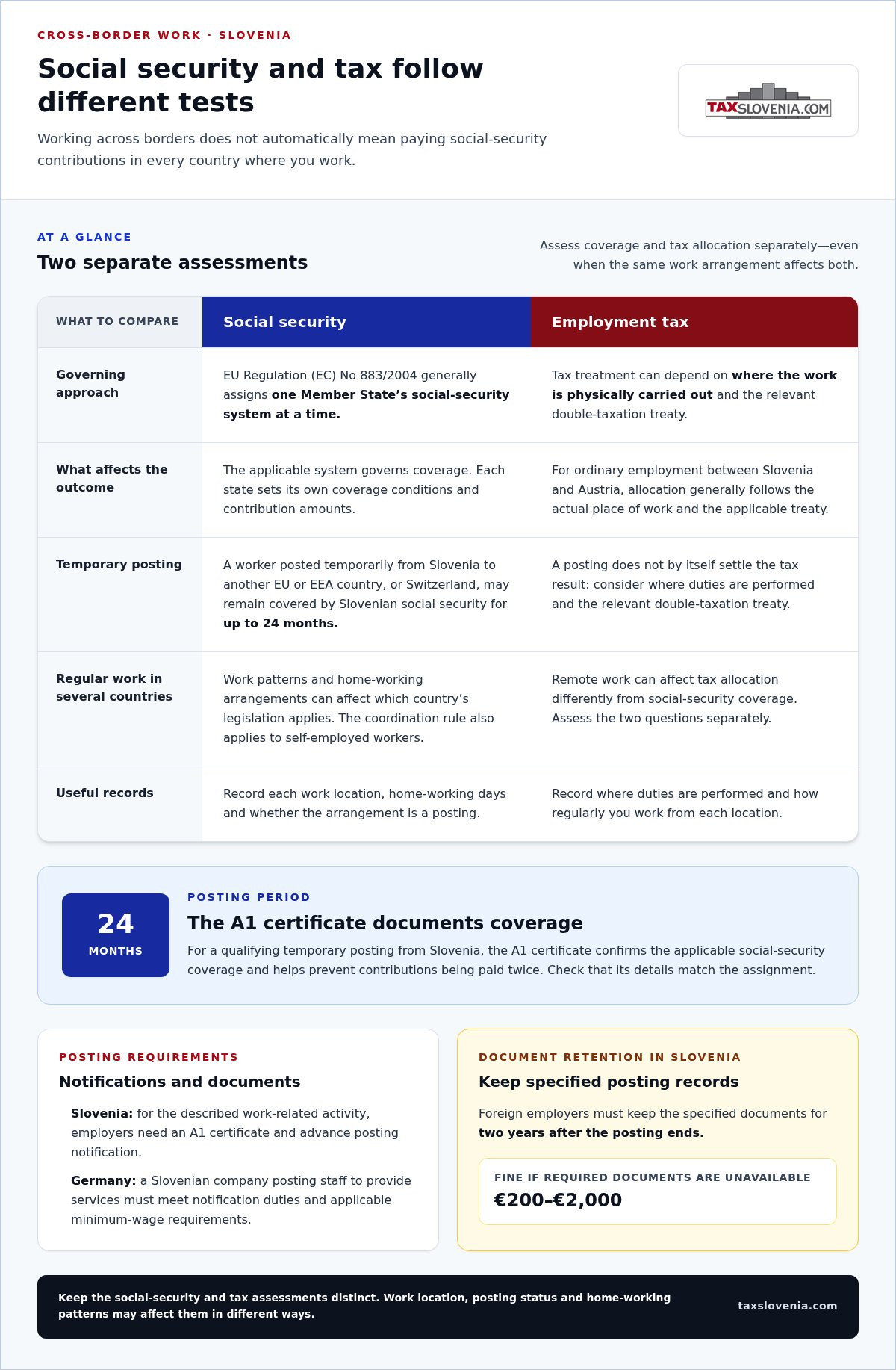
A posting is a temporary work assignment abroad during which coverage can remain with the home system. An employee temporarily posted from Slovenia to another EU or EEA country, or Switzerland, may remain covered by Slovenian social security for up to 24 months under Regulation (EC) No 883/2004. The A1 certificate confirms that coverage and helps prevent contributions being paid twice. Employers should ensure the certificate details match the assignment.
Social security across neighbouring borders
For employment involving Slovenia and a neighbouring country, the applicable country’s system governs social-security coverage. EU coordination rules also apply to work involving Slovenia’s neighbours, including Austria, Italy, Croatia and Hungary, although national coverage conditions and contribution amounts differ. Health insurance and pension coverage follow the applicable system. Unemployment benefits can also affect which country’s social-security legislation applies. Regular work in several states or working from home can affect the allocation, so record each work location and whether the arrangement is a posting.
Cross-border assignments and frontier-worker taxation
Tax treatment and posting obligations depend on where you work and which country’s rules apply. Slovenia’s rules also distinguish temporary assignments from employment carried out there.
Posted-worker notifications and registration
A posting notification informs the relevant state that an employee is temporarily working there. For the described work-related activity in Slovenia, employers need an A1 certificate and advance posting notification. In Germany, a Slovenian company posting staff to provide services must meet notification duties and applicable minimum-wage requirements. Breaches of posted-worker requirements in Slovenia can have financial consequences. This makes timely notification and accurate assignment details essential.
Documents and worker coverage
Posting documents record the employment and assignment details required during a cross-border placement. In Slovenia, foreign employers must keep the specified documents for two years after the posting ends; failure to keep required documents available can result in a €200 to €2,000 fine. German Minimum Wage Act and Posted Workers Act rules apply to posted workers’ working conditions. A non-EU national applying for Slovenia’s single residence and work permit needs a valid travel document, health insurance, sufficient means, a signed employment contract and a police clearance certificate without entries.
Contracts, payroll and employer registration
A Slovenian employment contract establishes the employment relationship and can support a foreign worker’s residence-permit application. Employers must report posted employees’ employment income monthly within the applicable deadlines. Slovenian social-security contributions are generally paid by both employer and employee. For taxation, ordinary employment between Slovenia and Austria is generally allocated according to the actual place of work and the applicable double-taxation treaty; there is no special frontier-worker tax rule for employment income. Slovenian tax residents are generally taxed on income earned at home and abroad.
Working regularly in multiple member states
Regular work in several Member States involves recurring duties in more than one country. Social-security coverage, tax allocation and working conditions require separate consideration.
For an employee working across states, EU coordination rules determine which country’s social-security system applies. The same applicable-legislation rule also applies to self-employed workers. Keep records of work locations and arrangements, including home-working days. Remote work can affect tax allocation and social-security coverage differently, so a Slovenian employer should assess these issues separately rather than treating every workday abroad as a posting.
Remote work from another country for an employer based in Slovenia can affect both tax allocation and social-security coverage. The two assessments do not necessarily follow the same approach. Record where you perform your duties and how regularly you work from each location.
Slovenia’s statutory working week is 40 hours. Article 144 of the Employment Relationships Act limits overtime to 8 hours per week, 20 hours per month and 170 hours per year; the daily limit is 10 hours. Overtime arrangements should be checked against the applicable employment rules. Night and weekend work are subject to special rules, so employers should distinguish these hours in work schedules and records. Employees are entitled to at least four weeks of paid annual leave. When you organise work across Slovenia and another country, compare the actual schedule with these Slovenian limits and track leave and overtime separately. This helps identify which hours fall within ordinary working time and which qualify as overtime under Slovenian rules.
TaxSlovenia: Steuerberatung für Unternehmen
TaxSlovenia provides business tax advice and HR and employment-law advice for companies managing work connected with Slovenia. Consider this support when planning a posting, hiring a foreign employee or reviewing how cross-border work affects payroll and tax responsibilities. Clear employment arrangements and accurate tax treatment matter when duties span more than one country. TaxSlovenia can help address the Slovenian tax and employment questions involved, including the obligations relevant to your business and workforce. Its services also include VAT registration and a special scheme for bus companies. Contact TaxSlovenia to discuss your Slovenian business or employment questions.
Plan your next cross-border employment steps
Turn the rules for cross-border employment in Slovenia into a clear plan for your organisation. Before changing a work arrangement or making a new hire, bring together the relevant employment terms, work locations and payroll details. This provides a sound basis for considering how Slovenian requirements apply and where specialist advice can support your decisions.
TaxSlovenia can help you assess the Slovenian tax and employment questions involved in your business arrangements. A focused discussion can help identify the issues that need attention and plan appropriate next steps for your employees and operations.
With a considered approach, you can manage cross-border work with greater clarity and make informed decisions as your organisation develops.
Frequently Asked Questions
How are income tax and double taxation handled for people working across the Slovenian border?
Employment income is generally allocated according to where you perform the work and the applicable double-taxation treaty. For ordinary employment between Slovenia and Croatia, the treaty has no special frontier-worker rule for employment income. If you’re tax-resident in Slovenia, you’re generally subject to Slovenian income tax on income earned both in Slovenia and abroad. Keep records showing where you worked and which income relates to each location.
Which country’s social security system covers cross-border workers in Slovenia?
Under Regulation (EC) No 883/2004, a worker covered by the EU coordination rules is subject to one Member State’s social-security legislation at a time. For example, an employee who lives in Slovenia and works in Germany is subject to German legislation. The applicable country’s rules determine social-insurance coverage and contributions, including the relevant health, pension and unemployment arrangements.
What are the requirements for an A1 certificate when working in Slovenia and another EU country?
An A1 certificate confirms which country’s social-security legislation covers you during cross-border work. For an employee posted from Slovenia, the Slovenian employer applies electronically through the SPOT portal, and the Health Insurance Institute of Slovenia (ZZZS) issues the certificate. An employer may apply up to 30 days before the planned start. A third-country national needs a valid Slovenian single residence and work permit before the employer applies.
What tax filing deadlines and documents do cross-border workers in Slovenia need?
For posted employees in Slovenia, employment income must generally be reported monthly within specified deadlines. The REK-1 obrazec is Slovenia’s standard tax return form for reporting income types. Keep the employment and pay information organised by reporting period and work location, so income relating to Slovenia can be distinguished from work performed elsewhere. The applicable filing deadline depends on the relevant reporting obligation.
How do cross-border employment rules in Slovenia compare with those in Austria, Italy, Croatia, and Hungary?
EU coordination rules apply to work involving Slovenia and Austria, Italy, Croatia and Hungary, assigning one country’s social-security legislation at a time. Each country sets its own coverage conditions and contribution amounts; tax allocation is assessed separately according to where the work is performed and the applicable treaty.
Disclaimer
The information provided in this article is for general informational purposes only and does not constitute tax, legal, accounting or other professional advice. Tax treatment may vary depending on the specific facts and circumstances, and legislation and administrative practice may change over time. Before making any decision or taking any action based on this information, we recommend obtaining professional advice tailored to your individual circumstances.


