
A company’s tax residence and its activities determine whether it needs corporate tax advice in Slovenia. For businesses with cross-border operations, TaxSlovenia.com can help clarify where tax applies and how expenses affect the taxable profit. Slovenia applies a 22% corporate income tax rate to the tax base for 2024-2028.
Knowing that a recorded business expense is not automatically tax-deductible is only the starting point. This article explains who may have corporate tax obligations in Slovenia, how deductible, non-deductible and restricted expenses affect taxable profit, and which reliefs may apply. It also explains why companies with a Slovenian subsidiary, branch or other business activity should understand the rules before preparing a corporate tax return.
Key Takeaways
- Identify whether your Slovenian presence is a subsidiary or a permanent establishment, as this affects which income is taxable there.
- Separate ordinary business costs from tax reliefs, since eligible research and development spending may receive specific treatment.
- Review shareholder-loan financing against Slovenia’s thin-capitalisation rule before calculating deductible interest.
- Understand how expense restrictions and available reliefs interact to determine the final taxable profit.
Tax Advisor in Slovenia
Slovenian corporate tax advice matters when your company is resident, earns Slovenian-source profits, or manages operations there. The applicable rate for 2024-2028 is 22% of the tax base.
Corporate Tax Liability for Companies
Corporate tax liability is a company’s obligation to pay tax on profits within Slovenia’s tax rules. A Slovenian-registered company is generally liable on worldwide income, while a foreign company’s branch is taxed on income directly earned in Slovenia. The corporate income tax rate was 19% through 2023 and is 22% for 2024-2028 under Article 64 of ZORZFS. Corporate tax rates vary between countries, so comparisons should be made cautiously. Returns for the preceding financial year are due by 31 March; advance payments are monthly above €400 and quarterly at or below €400.
Resident and Non-Resident Tax Liability
A resident company, such as a Slovenian d.o.o., is a separate legal entity with unlimited tax liability on worldwide income. A non-resident company generally faces limited liability on Slovenian-source income earned through a permanent establishment or permanent representative. Dividends paid to non-residents generally face 15% withholding, subject to treaty relief or applicable EU rules; the same general rate applies to payments to non-residents, including interest and royalties, subject to relief. The governing law is Zakon o davku od dohodkov pravnih oseb (ZDDPO-2).
Company Management and Corporate Tax
Where a company is actually managed can affect its Slovenian tax position. Cross-border groups should assess whether their activities create a permanent establishment, review related-party pricing and keep records supporting transactions. Inaccurate reporting can result in tax adjustments and penalties. Advice fees depend on the company’s structure, cross-border activity and records, with fees set on a time or fixed-price basis.
Taxable profit and deductible business expenses
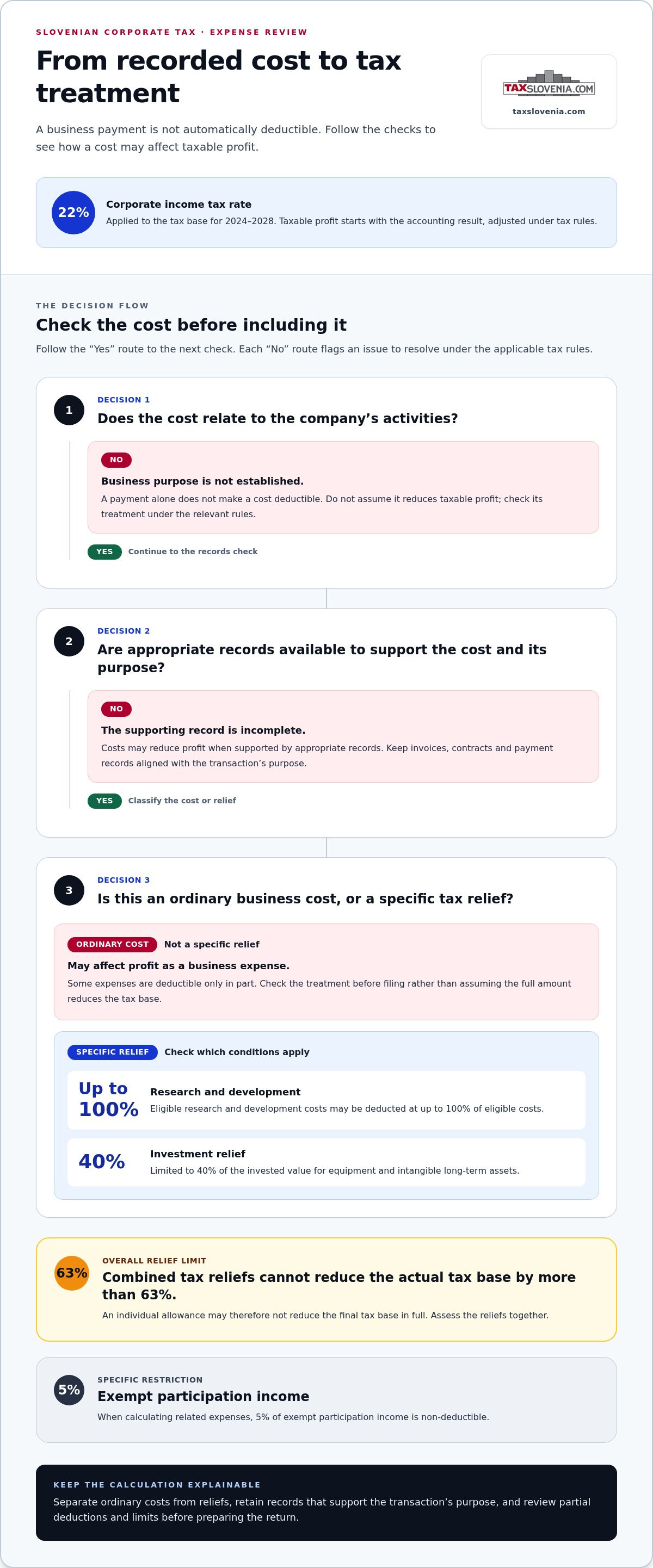
In Slovenia, taxable profit is based on a company’s accounting result, adjusted under tax rules to determine the final tax base. Business costs may reduce profit when they relate to the company’s activities and are supported by appropriate records. A payment alone does not make a cost deductible: establish its business purpose and classify it under the relevant rules. TaxSlovenia’s corporate tax advice helps businesses assess how eligible expenses affect the calculation.
Distinguish ordinary deductible expenses from tax reliefs. An operating cost affects the calculation of profit, while an investment allowance or employment relief may reduce the tax base if specific conditions are met. The distinction matters when a Slovenian company buys equipment, funds research or pays for services in the EU or elsewhere. TaxSlovenia advises businesses on the applicable treatment.
- Research and development costs may be deducted at up to 100% of eligible costs.
- Investment relief for equipment and intangible long-term assets is limited to 40% of the invested value.
- Tax reliefs together may reduce the actual tax base by no more than 63%.
- Some business expenses may be deductible only in part, so check their treatment before filing.
For example, an enterprise investing in equipment should record the asset and its qualifying investment value separately from routine service costs. The 40% investment relief is subject to the overall 63% limit, so the full allowance may not reduce the final tax base. Keep invoices, contracts and payment records aligned with the transaction’s purpose. For exempt participation income, 5% of that income is non-deductible when calculating related expenses.
Reviewing the tax treatment before filing can help identify eligible reliefs and disallowed amounts. For support with Slovenian business tax calculations, discuss your corporate tax position.
Non-deductible and restricted expenses
Slovenia’s thin-capitalisation rule restricts interest deductions on shareholder loans. Interest is generally allowed only when the equity-to-debt ratio is at least 1:4. This makes the company’s capital structure relevant when calculating taxable income. A tax adviser can assess how the ratio affects the treatment of shareholder-loan interest.
For example, a company with equity of one part and shareholder debt of four parts reaches the stated ratio. If shareholder debt exceeds that relationship, do not assume every interest payment will reduce the tax base. The rule concerns shareholder loans, so identify the lender and classify the financing arrangement accurately. An ordinary supplier invoice is a different kind of liability.
Review the relevant balances together rather than assessing each payment in isolation. Compare the loan agreement, lender identity and recorded capital figures to distinguish shareholder financing from other liabilities and show how the ratio was calculated. For companies whose owners or related parties are in other European countries, clear records also help explain the arrangement’s business purpose. TaxSlovenia can advise on how the restriction applies.
Before filing, reconcile the interest recorded in the accounts with the loan information and the company’s equity position. Keep the calculation with the supporting records, so the tax treatment can be explained if the Slovenian tax office raises questions. The key test is the 1:4 relationship, not simply whether the company made an interest payment. Review changes in capital or debt during the relevant period.
TaxSlovenia: Corporate tax advice
TaxSlovenia provides corporate tax advice to businesses operating in Slovenia. This service can help your company assess its Slovenian tax residence, report local profits and distinguish deductible expenses from restricted costs. Advice can also cover how shareholder financing and investment relief affect the taxable base.
If your Slovenian operations involve employees, TaxSlovenia’s HR and employment-law advice can address related employment matters. Companies making taxable supplies may also need VAT registration, while bus operators can seek guidance on the special regime for bus companies. These services address different obligations, so the right support depends on your business activity.
Contact TaxSlovenia to discuss your company’s Slovenian tax position.
Plan your next Slovenian tax decisions
Corporate tax advice in Slovenia can help connect business decisions with their tax consequences. Before approving an investment, changing shareholder financing or expanding cross-border activity, document the commercial purpose, expected transactions and records your team will retain. This gives management a clearer basis for comparing options and discussing their tax treatment before making commitments. The analysis depends on your company’s structure and planned activities.
TaxSlovenia can help assess these decisions through its corporate tax advisory service. Prepare a brief outline of the issue, the entities involved and the records available. This creates a practical starting point for focusing on the tax questions that matter to your business.
Discuss your Slovenian tax position With a clear plan and well-organized records, you can approach your next business decision with greater confidence.
Frequently Asked Questions
What is Slovenia’s current corporate income tax rate?
Slovenia’s corporate income tax rate is 22% for tax years 2024-2028. For budgeting, match the rate to the accounting period being reported rather than the date you prepare the return. Keep this rate separate from withholding taxes on distributions or other payments, which follow different rules and may depend on treaty relief and transaction type.
How is corporate income tax calculated in Slovenia?
Slovenia’s tax year is generally the calendar year. A company may change its tax year by notifying the tax office, so confirm the accounting period before aligning internal reporting and tax calculations. This is especially relevant when a group’s financial year differs from the calendar year. Consistent period definitions help reconcile group information with the Slovenian filing.
Which companies are subject to corporate income tax in Slovenia?
Slovenian legal entities carrying on business can fall within corporate income tax rules, while investment funds, pension insurance companies and insurance companies have a 0% rate. The entity’s legal classification therefore matters alongside its activities. A group should identify which entity earns each income stream, rather than assume a parent’s tax treatment applies automatically to its subsidiaries.
What tax deductions, allowances, and incentives are available to Slovenian companies?
Potential relief includes qualifying employment incentives and participation gains. A taxpayer employing a person difficult to place in work may claim relief equal to 45% of salary paid during the first 24 months, capped at the tax base. Gains from qualifying company participations may receive a 50% exclusion where the company holds at least 8% for at least 6 months.
How can a foreign company find a qualified corporate tax adviser in Slovenia?
Foreign businesses should seek advice that covers Slovenian corporate tax and cross-border transactions. Prepare the company’s incorporation details, management records, contracts and previous filings to make the discussion concrete. Groups based in Germany, Austria or Switzerland should also outline how their Slovenian operations connect with the parent entity. This helps focus the advice on the group’s actual structure and activities.
Disclaimer
The information provided in this article is for general informational purposes only and does not constitute tax, legal, accounting or other professional advice. Tax treatment may vary depending on the specific facts and circumstances, and legislation and administrative practice may change over time. Before making any decision or taking any action based on this information, we recommend obtaining professional advice tailored to your individual circumstances.


