
The VAT return deadline is not the only date that matters. For accounting and reporting in Slovenia, VAT-registered entities, including businesses without a physical presence, must submit Sales and Purchase Ledgers alongside their VAT returns from 1 July 2025. The ledgers are due with the return, but submitting them at least 3 working days earlier allows FURS to pre-fill it.
It can be difficult to distinguish this ledger deadline from the rules for fiscalised receipts and electronic invoices. This article explains which businesses are covered, how reporting requirements work and how the ledger submission date affects pre-filled VAT returns. It also outlines where fiscalisation applies and how requirements differ for transactions with public bodies, businesses and consumers.
Key Takeaways
- Separate fiscalised receipt rules from VAT ledger reporting: payment methods such as cash, cards, cheques and advances can bring a transaction within fiscalisation.
- Understand how structured XML data records invoice details, VAT amounts and links to related documents for FURS reporting.
- Identify how Slovenia’s domestic B2B e-invoicing mandate from 1 January 2028 relates to businesses registered in the Slovenian Business Register.
- Use the reporting rules to assess where Slovenian tax and accounting support can help with your business obligations.
Slovenia's fiscalisation system and FURS reporting
In Slovenia, fiscalisation and VAT ledger reporting are separate obligations. Under ZDavPR, fiscalisation covers transactions paid fully or partly by cash, cards, cheques or similar non-bank transfers, including advances, for B2B and B2C sales. Receipt data goes to the Financial Administration of the Republic of Slovenia (FURS) in structured XML. Businesses managing Reporting Slowenien Buchhaltung must distinguish this receipt process from VAT ledger reporting through e-Davki.
Slovenian VAT ledger reporting is based on Article 85a of ZDDV-1 and Article 150a of the VAT Rules. From 1 July 2025, VAT-registered entities, including businesses without a physical presence in Slovenia, must submit ledgers with the corresponding VAT return. Records cover invoices, tax bases, rates, VAT amounts and links to credit notes, debit notes and advance payments.
The initial e-invoicing proposal included reporting transaction data within eight days. The final B2B mandate does not require each invoice to be sent to FURS. Slovenia adopted its B2B e-invoicing law on 23 October 2025, with the mandate taking effect on 1 January 2028. Accepted formats include e-SLOG and EN 16931. Public-sector e-invoices have been mandatory since 2015.
Companies must retain electronic invoices and equivalent documents generally for 10 years, or 20 years for real-estate transactions. Applicable accounting standards and financial reporting rules depend on the entity’s reporting framework. For Reporting Slowenien Buchhaltung, annual statement filing also depends on the entity’s reporting category.
Payroll accounting involves recording pay, related tax reporting and employee social contributions. Foreign-owned businesses need accounting processes suited to their Slovenian registration and obligations. Bookkeeping costs depend on transaction volume, payroll and reporting complexity. Under ZDPR-1, responsible persons risk €1,200-€10,000 for first offences; sole proprietors and self-employed people risk €3,000-€50,000. The Reporting Slowenien Buchhaltung process should account for the breach and entity when assessing penalty exposure.
Businesses covered by the reporting requirement
For a business based in Germany, Austria or Belgium, Slovenian reporting depends on its activities and registration in Slovenia. The proposed e-invoicing framework covers entities entered in Slovenia’s Business Register (PRS), including companies, self-employed people and associations. Inclusion requires a registered office or address in Slovenia.
The proposed reporting scope includes domestic and cross-border B2B transactions. It would require transaction data to be reported even when an invoice is issued on paper. This matters to a German company in Munich selling to a Slovenian business, for example: the cross-border nature of the sale does not by itself remove it from the proposed scope. The final domestic B2B e-invoicing mandate takes effect on 1 January 2028.
Sole traders, limited companies and foreign branches should assess their Slovenian registration and VAT status separately. A branch’s foreign head office does not determine whether its Slovenian presence is recorded in the PRS or whether it is VAT-registered. This distinction matters for businesses managing operations from Vienna, Düsseldorf or elsewhere in Germany, Austria and Switzerland.
To prepare, map the Slovenian legal entity or branch, its registrations and its B2B transaction routes. Document which sales are domestic or cross-border, and whether invoices are paper or electronic. Then update accounting workflows to capture the data required for each reporting obligation. Keep VAT ledger reporting distinct from the upcoming e-invoicing mandate, since they are related but separate compliance processes.
If your cross-border structure includes Slovenian activity, discuss your reporting scope.
Ledger submission deadlines and VAT return pre-filling
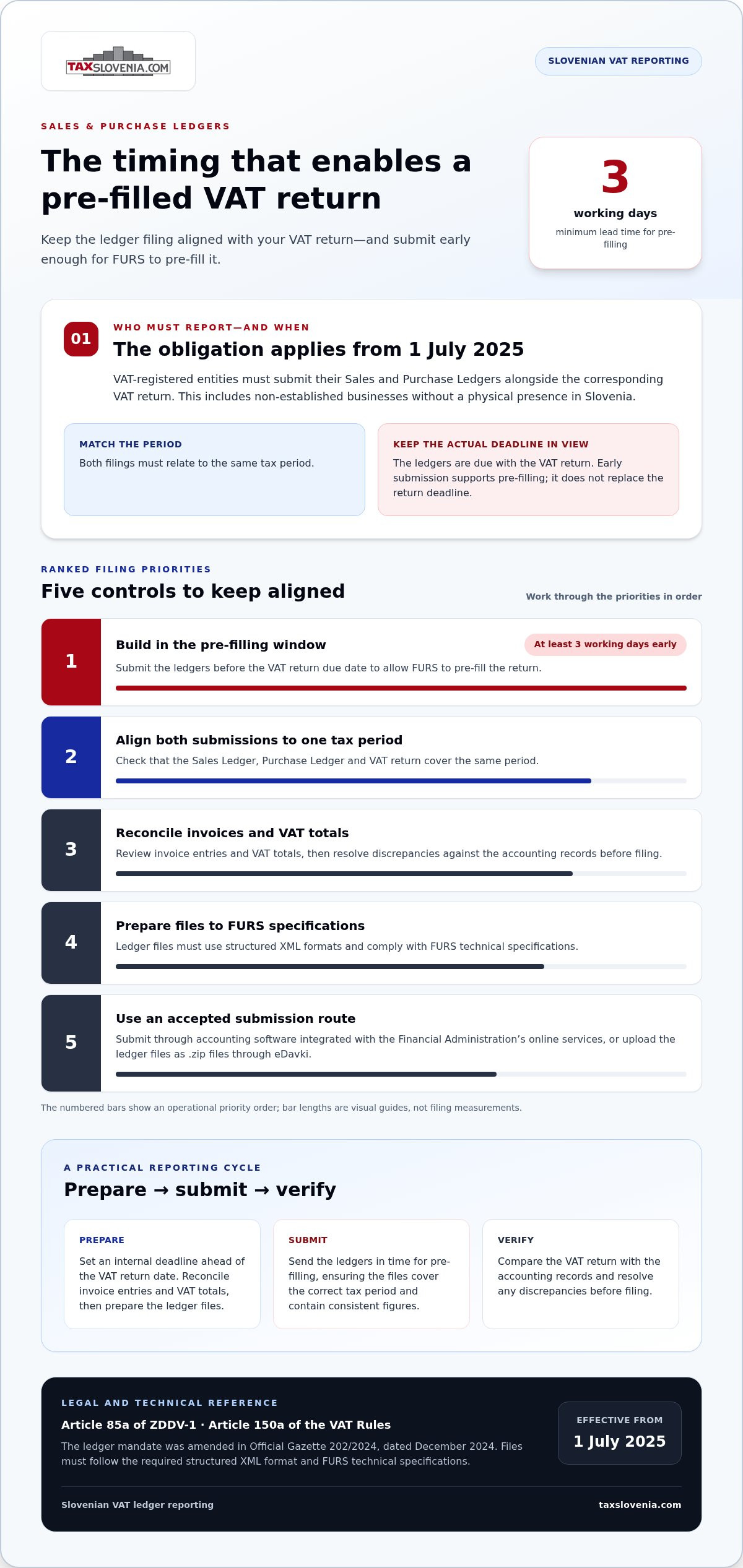
From 1 July 2025, VAT-registered entities in Slovenia must submit Sales and Purchase Ledgers alongside VAT returns. This includes non-established businesses without a physical presence in the country. Both filings must relate to the same tax period. For teams responsible for Reporting Slowenien Buchhaltung, coordinating ledger preparation with the return helps keep the reporting cycle organised.
To allow the Financial Administration to pre-fill a VAT return, submit the ledgers at least 3 working days before its due date. Use that interval to review the figures and check that the ledger data matches the relevant accounting period. Pre-filling supports the return process, but the submitted figures still need to be reviewed against the business records.
Taxpayers can submit through accounting software integrated with the Financial Administration’s online services, or upload the ledgers as .zip files through eDavki. The Financial Administration announced these methods on 5 May 2025. Before submitting, confirm that the files cover the correct tax period and contain consistent figures. International businesses using global software should ensure that its Slovenian reporting output meets FURS technical specifications.
Set a recurring internal deadline ahead of each VAT return date. Reconcile invoice entries and VAT totals, prepare the ledger files, then submit them in time for pre-filling. Compare the return with the accounting records and resolve any discrepancies before filing. This sequence gives teams a practical way to manage Reporting Slowenien Buchhaltung across reporting periods.
The VAT ledger mandate was amended in Official Gazette 202/2024, dated December 2024. Files must use structured XML formats and comply with FURS technical specifications.
TaxSlovenia: Steuerberatung für Unternehmen
TaxSlovenia supports businesses that need to understand Slovenian tax obligations alongside their FURS reporting responsibilities. Its Steuerberatung für Unternehmen can help assess how registration, business activity and transaction flows affect your tax position. This is useful when establishing a Slovenian operation, expanding cross-border activity from Germany, Austria or Switzerland, or reviewing reporting arrangements.
If your activity creates a Slovenian VAT registration obligation, TaxSlovenia provides MwSt-Registrierung. Bus operators can also get support with the Sonderregelung für Busunternehmen, including the relevant special VAT procedure. Where staff arrangements raise employment or workplace questions, HR- und Arbeitsrechtsberatung can address that part of the compliance picture.
For a discussion of your Slovenian tax or VAT reporting needs, contact TaxSlovenia.
Build a consistent reporting process
Reliable Slovenian bookkeeping and reporting start with clear responsibility at each stage, from recording transactions to reviewing submissions. Treat the accounting calendar as an operating tool, not just a list of filing dates. This helps your team organise records, resolve discrepancies and maintain continuity when staff or business activities change.
Before the next reporting cycle, identify who prepares the underlying records, who checks them and who submits the required returns. Align those roles with your business structure and cross-border activity. A documented process makes it easier to spot missing information and address it before a filing is due.
TaxSlovenia can discuss the accounting and tax support relevant to your Slovenian operations. This is a practical next step from understanding the rules to managing them consistently.
With defined responsibilities and a practical routine, reporting can become a more orderly part of running your business.
Frequently Asked Questions
What are Slovenia's VAT registration thresholds, rates, filing deadlines, and invoicing rules?
The applicable VAT rate depends on the goods or services supplied and their classification. VAT returns follow the taxpayer’s assigned reporting period. An invoice generally must be issued no later than within 15 days of the month following the taxable supply, so a March supply must be invoiced by 15 April.
How do accounting requirements differ for Slovenian sole traders, limited companies, and foreign branches?
Sole traders, limited companies and foreign branches should assess their Slovenian registration and VAT status separately. A foreign head office alone does not determine whether a branch is recorded in the Slovenian Business Register or VAT-registered.
How can a foreign-owned business set up accounting and appoint an accountant in Slovenia?
Map the Slovenian entity or branch, its registrations and transaction routes, then set up accounting processes to capture the data required for each reporting obligation.
Disclaimer
The information provided in this article is for general informational purposes only and does not constitute tax, legal, accounting or other professional advice. Tax treatment may vary depending on the specific facts and circumstances, and legislation and administrative practice may change over time. Before making any decision or taking any action based on this information, we recommend obtaining professional advice tailored to your individual circumstances.


