
Could an employee working from Slovenia bring your Swiss company under Slovenian social security rules? The answer depends on where the employee physically works and how they divide their time. For Swiss employers, the practical question is how to hire remote staff in Slovenia and meet the applicable social security reporting duties: Remote Mitarbeiter in Slowenien anstellen Sozialversicherung Meldepflicht Schweiz.
A Swiss employment contract does not, by itself, determine which country’s social security system applies. Cross-border telework can affect the outcome. This guide explains the general rules and the telework exception, including when an A1 certificate may be relevant. It also outlines the Slovenian registration, payroll, contribution and reporting requirements to assess, and explains why tax treatment is a separate question. Use the employee’s actual work pattern to identify the relevant framework and plan for local compliance before employment begins.
Key Takeaways
- Distinguish an employee who works only in Slovenia from one who regularly works in both Slovenia and Switzerland. The physical work pattern affects which social security system may apply.
- For Remote Mitarbeiter in Slowenien anstellen Sozialversicherung Meldepflicht Schweiz, assess whether the cross-border telework exception and an A1 certificate are relevant to the employee’s work pattern.
- Map the applicable Slovenian employer registration, payroll, contribution and reporting requirements before employment begins.
- Use locally informed HR, employment and accounting support to address Slovenian compliance, and review the arrangements if the employee’s work pattern changes.
Which country’s social security rules apply when a Swiss employer hires in Slovenia?
An employee who performs all their work in Slovenia is in a different position from one who regularly works in both Slovenia and Switzerland. Social security coordination rules, rather than the contract’s governing law alone, determine which system applies. For a Swiss employer, the relevant framework is the Switzerland-EU coordination arrangement under the Agreement on the Free Movement of Persons (AFMP).
Begin by recording the employee’s country of residence, each regular work location, the expected work pattern and the employer’s location. Establish whether the arrangement is a temporary assignment or an ongoing employment pattern. These details help determine which country’s system applies and whether registration or an A1 certificate needs consideration. An overview of Social security in Switzerland can help you understand the Swiss side of the coordination question.
How does the employee’s work pattern change the assessment?
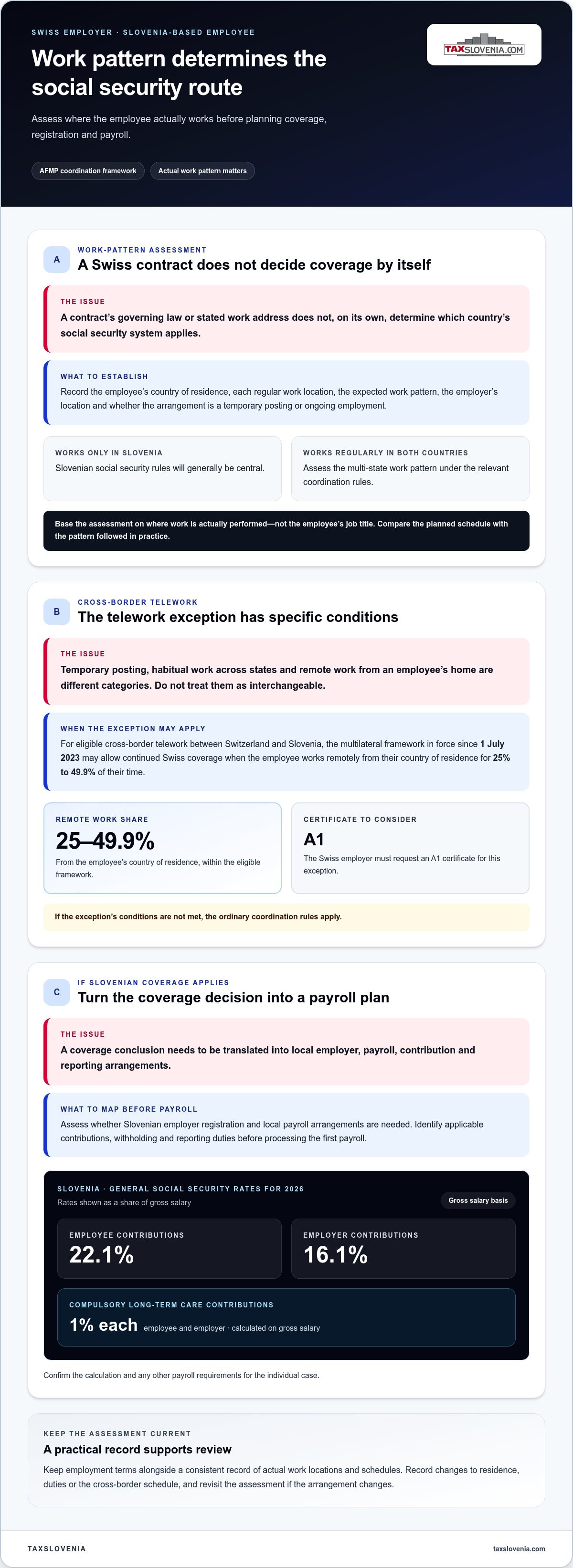
If the employee lives and works solely in Slovenia, Slovenian social security rules will generally be central. Regular work in both countries requires a multi-state assessment based on the actual pattern, not the employee’s job title or the work address stated in the contract.
Keep the relevant work arrangements distinct. A temporary posting, habitual work across several states and remote work from an employee’s home are not interchangeable categories. For eligible cross-border telework between Switzerland and Slovenia, the multilateral framework in force since 1 July 2023 may allow continued Swiss coverage when the employee works remotely from their country of residence for 25% to 49.9% of their time. The Swiss employer must request an A1 certificate for this exception. If its conditions are not met, the ordinary coordination rules apply.
For Remote Mitarbeiter in Slowenien anstellen Sozialversicherung Meldepflicht Schweiz, the practical starting point is a record of where the employee actually works and how the arrangement is structured. Compare the planned schedule with the schedule followed in practice, and revisit the assessment if either changes.
What social security and reporting steps should a Swiss employer assess?
Once you have identified the likely social security system, translate that conclusion into a documented payroll plan. The Agreement on the free movement of persons between Switzerland and the EU provides the coordination framework. The employer’s next steps depend on the employee’s circumstances and the system that applies.
- Record the work pattern. Note the employee’s residence, employment start date and every regular work location. Document the expected division of work between Slovenia and Switzerland. Keep a calendar or other consistent record of work locations, and update it if the arrangement changes.
- Determine the applicable system. Assess the facts under the relevant coordination rules. If an application or certificate may be needed, identify the route that applies to the Swiss-Slovenian arrangement instead of relying on procedures used for employers in Germany or Austria.
- Map registration and payroll requirements. If Slovenian rules apply, assess whether the Swiss employer needs Slovenian employer registration and local payroll arrangements. Identify the applicable contributions, withholding and reporting duties before processing the first payroll.
For 2026, Slovenia’s general social security rates include employee contributions of 22.1% and employer contributions of 16.1% of gross salary. Compulsory long-term care contributions add 1% for each, calculated on gross salary. These rates are relevant when Slovenian coverage applies. Confirm the calculation and any other payroll requirements for the individual case.
What information should the employer assemble before payroll is set up?
Keep the employment terms together with a practical record of where work is actually performed. The file should make it easy to compare the agreed arrangement with the employee’s work locations and schedule. Record changes to residence, duties or the cross-border schedule, since these may affect the assessment. Clarify who will run payroll and maintain the records needed to support contribution calculations and reporting.
TaxSlovenia provides HR, employment and accounting support for employment relationships involving foreign employers. You can discuss your Slovenian employment and payroll requirements as part of your assessment.
How can you manage the Slovenian compliance process with local support?
After assessing which social security system applies, turn the conclusion into a clear Slovenian compliance plan. Confirm the coverage position and any certificate or application requirements for the specific work arrangement. Then map the employment, payroll, contribution and reporting requirements that follow under Slovenian rules. Keep a record of the basis for each decision so the setup can be reviewed if the employee’s duties or work locations change.
TaxSlovenia supports employment relationships involving foreign employers with HR and employment advice alongside accounting services. This connects the employment arrangements with Slovenian payroll and record-keeping, rather than treating each obligation in isolation. For a Swiss employer, agree who manages each local task and what information must be maintained as the arrangement develops. Employers based in Germany or Austria should likewise assess their own cross-border arrangements under the relevant coordination framework rather than applying a Swiss-specific process by default.
Planning advisory and payroll support together can help you define the scope of work and understand the associated fees. TaxSlovenia offers advisory services on an hourly or fixed-fee basis, and recurring fees for ongoing accounting and payroll services. The right arrangement depends on the work required. The compliance steps for Remote Mitarbeiter in Slowenien anstellen Sozialversicherung Meldepflicht Schweiz should reflect the employee’s actual circumstances, not a generic cross-border template.
When is specialist advice useful for a Swiss employer?
Local advice is particularly useful when the employee regularly works in both countries, or when a change in residence, duties or schedule could affect the assessment. Coordinated HR, employment and accounting support can help you organise Slovenian requirements, allocate responsibilities and keep supporting records consistent. This gives your business a practical route from the initial coverage decision to ongoing local administration.
Before the employee’s start date, make sure the planned working arrangement is reflected in your payroll and administration decisions. A clear process also gives you a basis for reviewing the setup if the employee’s work pattern changes. Contact TaxSlovenia to discuss your Slovenian employment plans and organise the next steps for your employee and payroll arrangements.
Frequently Asked Questions
Can a Swiss company employ someone who works remotely from Slovenia without opening a Slovenian company?
Yes, a Swiss company can generally employ a person in Slovenia without setting up a Slovenian company. Make the employment file clear: identify the employing entity, describe the role, and record the agreed work location and start date. These details help keep the contract and onboarding records consistent with how the job is intended to operate.
Does a Swiss employer need an A1 certificate for an employee working from Slovenia?
Not automatically. If an A1 certificate is issued, check that it names the correct employee and matches the period and work arrangement it is intended to cover. A certificate connected to an earlier posting or a different work pattern should not be assumed to cover a changed remote-work setup. Keep the supporting work-pattern records alongside the certificate.
Could employing a remote worker in Slovenia create tax obligations for the Swiss company?
It could. For a focused tax review, prepare a calendar of the employee’s working days by country, alongside payroll periods and salary records. Separating Slovenian workdays from days worked in Switzerland gives a clearer basis for assessing the treatment of employment income under the applicable treaty. Keep the calendar current as the employee’s schedule develops.
Disclaimer
The information provided in this article is for general informational purposes only and does not constitute tax, legal, accounting or other professional advice. Tax treatment may vary depending on the specific facts and circumstances, and legislation and administrative practice may change over time. Before making any decision or taking any action based on this information, we recommend obtaining professional advice tailored to your individual circumstances.


