

If you own a Slovenian d.o.o. and live in Linz, deciding how to take money from the company requires more than comparing tax rates. If you are searching for “Steuerberater d.o.o. Slowenien Gewinnentnahme Optimierung für Inhaber aus Linz”, start by considering both the company’s position in Slovenia and your personal tax position in Austria.
The right questions depend on how the payment is structured, your role in the company and the records available. Remuneration for work and a Gewinnausschüttung, or distribution of profit to shareholders, are different routes and should be assessed separately. This article explains what to compare and what to prepare before making a decision. TaxSlovenia provides tax consulting and accounting for businesses and individuals with Slovenian tax matters, drawing on local expertise and collaboration with tax experts in Austria and Germany.
Key Takeaways
- Assess company profit separately from your personal income, taking account of your residence in Linz and the d.o.o.’s Slovenian circumstances.
- Compare remuneration and a Gewinnausschüttung by looking at your role, the company’s cash requirements, the proposed amount and timing, and the supporting records.
- For Steuerberater d.o.o. Slowenien Gewinnentnahme Optimierung für Inhaber aus Linz, prepare the company accounts, ownership details, residence information and proposed transaction for a focused review.
- TaxSlovenia’s tax consulting and accounting services support a review of Slovenian company matters and cross-border questions relevant to owners in Austria, Germany and Switzerland.
Slovenian d.o.o. profit extraction for Linz owners: what needs to be assessed?
Taking profit from a Slovenian d.o.o. affects both the company and its owner. Company funds are not automatically personal income. The business may need cash for operating costs, planned investment or other commitments, and an accounting profit figure alone does not establish what can be paid to an owner. Assess the proposed transaction in its legal, accounting and tax context before transferring funds.
For an owner living in Linz, the company’s Slovenian circumstances and the owner’s Austrian residence are both relevant. Reviewing only the company accounts may miss personal factors; looking only at the owner’s position may overlook the company’s finances, ownership structure or records. The applicable treatment depends on the verified facts in both countries.
There is no single extraction route that is automatically more tax-efficient for every owner. For Steuerberater d.o.o. Slowenien Gewinnentnahme Optimierung für Inhaber aus Linz, begin with the actual company and owner circumstances, not a general comparison of headline rates.
Which cross-border facts shape an owner’s starting position?
Start by recording four points: where you are tax-resident, your ownership share, your management role in the d.o.o. and how you intend to use the funds. For example, an owner who works in and manages the company and wants regular payments is considering a different set of facts from a passive shareholder planning a one-off distribution. These details help define the questions for review, but do not determine the tax treatment on their own.
Also note where you perform your work, how the proposed payment will be documented and whether there have been changes in your residence, role or ownership. General explanations can help you frame the decision, but current Slovenian and Austrian rules and your individual circumstances need specific analysis before you decide how or when to take money out.
How should you compare remuneration and Gewinnausschüttung?
Compare the two routes as distinct options, not simply as different tax rates. Remuneration relates to your work and role in the company. A Gewinnausschüttung is a distribution of company profit to shareholders. The company’s accounting treatment and your personal tax position are separate parts of the analysis. A headline rate cannot show how a proposed payment fits the company’s accounts, your circumstances or the rules that apply in both countries.
For each option, set out the company’s expected cash requirements, your responsibilities, the proposed amount and timing, and the documents that support the payment. These facts help structure the comparison; they do not establish a tax result. The current Slovenian and Austrian treatment needs individual review. The Slovenian Ministry of Finance provides official information on Slovenian tax policy, while applying the rules to your circumstances requires a cross-border assessment.
What should the comparison table help you decide?
Use this framework to organise the information for your adviser. It distinguishes company records from owner-level details and helps identify which questions still need review.
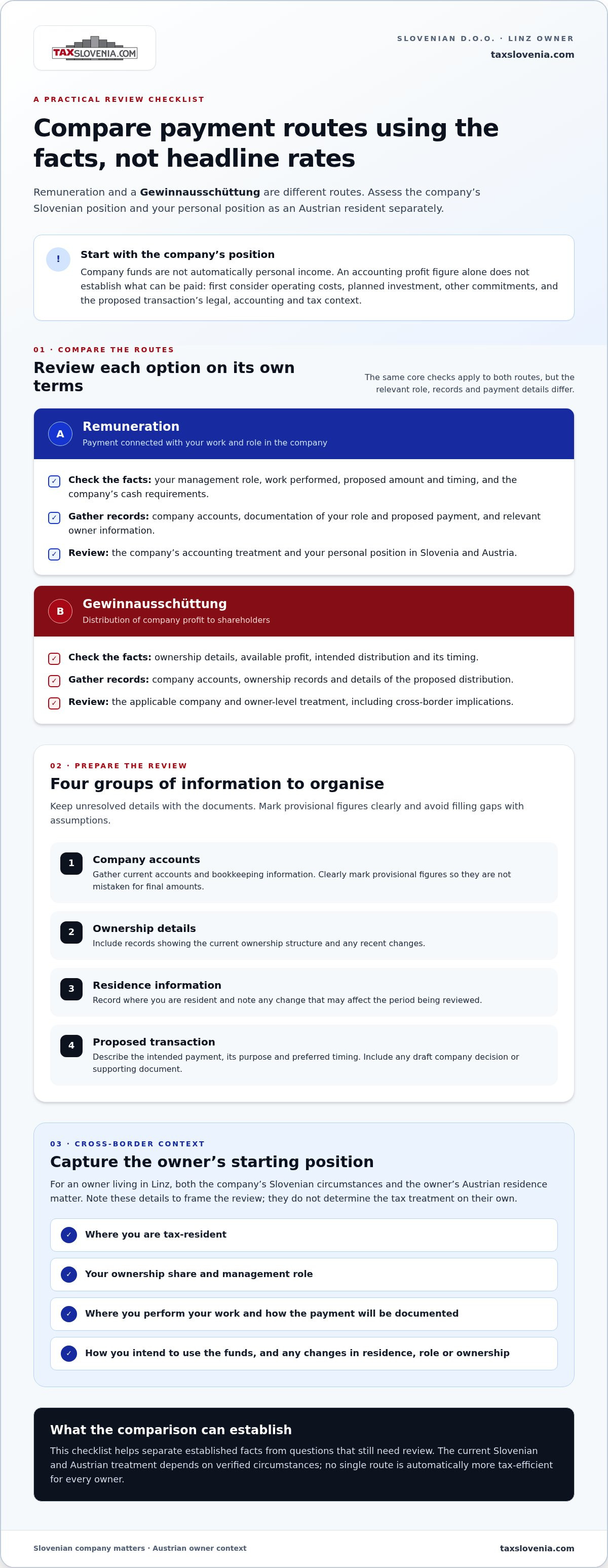
Route: Remuneration. Relevant facts: Your management role, work performed, proposed amount and timing, and the company’s cash needs. Records needed: Company accounts, documentation of your role and the proposed payment, and relevant owner information. Review: The company’s accounting treatment and your personal position in Slovenia and Austria.
Route: Gewinnausschüttung. Relevant facts: Ownership details, available profit, the intended distribution and its timing. Records needed: Accounts, ownership records and details of the proposed distribution. Review: The applicable company and owner-level treatment, including cross-border implications.
A Steuerberater d.o.o. Slowenien Gewinnentnahme Optimierung für Inhaber aus Linz discussion can use this comparison to identify what is established and what needs review. TaxSlovenia provides tax consulting informed by Slovenian and Austrian expertise. Advisory work is billed on an hourly or fixed-fee basis, depending on the engagement. To discuss your situation, get in touch about your d.o.o. tax position.
Plan your Slovenian d.o.o. tax advice: from records to next steps
Prepare the information needed to assess the proposed transaction against the company’s records and your circumstances. This sequence makes the review more focused:
- Company accounts: Gather current accounts and bookkeeping information. Mark provisional figures clearly so they are not mistaken for final amounts.
- Ownership details: Include records showing the current ownership structure and any recent changes.
- Residence information: Record where you are resident and note any change that may affect the period being reviewed.
- Proposed transaction: Describe the intended payment, its purpose and preferred timing. Include any draft company decision or supporting document.
Keep questions and unresolved details with the documents rather than filling gaps with assumptions. TaxSlovenia provides accounting services that can help establish a clear company-record basis for the discussion. Recurring monthly fees apply to bookkeeping and payroll services, while annual accounts and required filings form part of the accounting support. The scope and fee depend on the work involved.
What happens in a focused advisory discussion?
A focused discussion can distinguish established facts from missing information and identify issues that need current review before you decide. You can also agree practical next steps, such as gathering records or clarifying the proposed payment. TaxSlovenia provides tax consulting for businesses and individuals with Slovenian tax matters, including support for international clients. The aim is to assess your circumstances, not to presume a particular tax result or saving.
Prepare your documents and questions, then contact TaxSlovenia about your Slovenian d.o.o. circumstances.
Turn your next decision into a clear plan
Before committing to a payment, decide what you need it to achieve and which uncertainties must be resolved first. A short decision brief can keep the discussion focused on your priorities, the company’s cash needs and the records supporting the proposed transaction. For Steuerberater d.o.o. Slowenien Gewinnentnahme Optimierung für Inhaber aus Linz, the useful outcome is a clear basis for deciding what to examine next, not a predetermined extraction route.
Resolve open questions before acting. A careful review of the company and owner’s circumstances can help you make an informed decision.
TaxSlovenia works with clients in Austria, Germany and Switzerland who have Slovenian tax questions. Share your company details and proposed transaction to start a focused discussion.
Frequently Asked Questions
Can I take profit out of a Slovenian d.o.o. while living in Linz?
Living in Linz does not by itself determine the tax result or establish how a payment should be made. First clarify whether the proposed payment is remuneration or a distribution, and gather the company information supporting it. A review of the relevant facts and current rules can help you assess the transaction before acting.
Is a salary or Gewinnausschüttung more tax-efficient for a Slovenian d.o.o. owner?
Neither option is universally more tax-efficient. The comparison depends on your circumstances, the d.o.o.’s accounts and the proposed payment, so headline rates alone may leave out relevant factors. A Steuerberater d.o.o. Slowenien Gewinnentnahme Optimierung für Inhaber aus Linz review should compare both options using consistent assumptions and consider the current Slovenian and Austrian rules before you decide.
What records should I prepare before discussing d.o.o. profit extraction?
Gather current accounting information and ownership records, along with any draft payment proposal or related company documents. Separate final figures from provisional ones, and note previous payments to you that may be relevant. This gives the adviser a clearer picture of what is planned and helps identify any missing information.
Can TaxSlovenia advise owners based in Linz about a Slovenian company?
Yes. TaxSlovenia provides tax consulting and accounting for businesses and individuals with Slovenian tax matters, including support for international clients. Its work draws on experience in Slovenian, European and international tax law, collaboration with tax experts in Austria and Germany, and local Slovenian expertise. To make the discussion specific, explain your company structure and the payment you are considering.
Disclaimer
The information provided in this article is for general informational purposes only and does not constitute tax, legal, accounting or other professional advice. Tax treatment may vary depending on the specific facts and circumstances, and legislation and administrative practice may change over time. Before making any decision or taking any action based on this information, we recommend obtaining professional advice tailored to your individual circumstances.


