

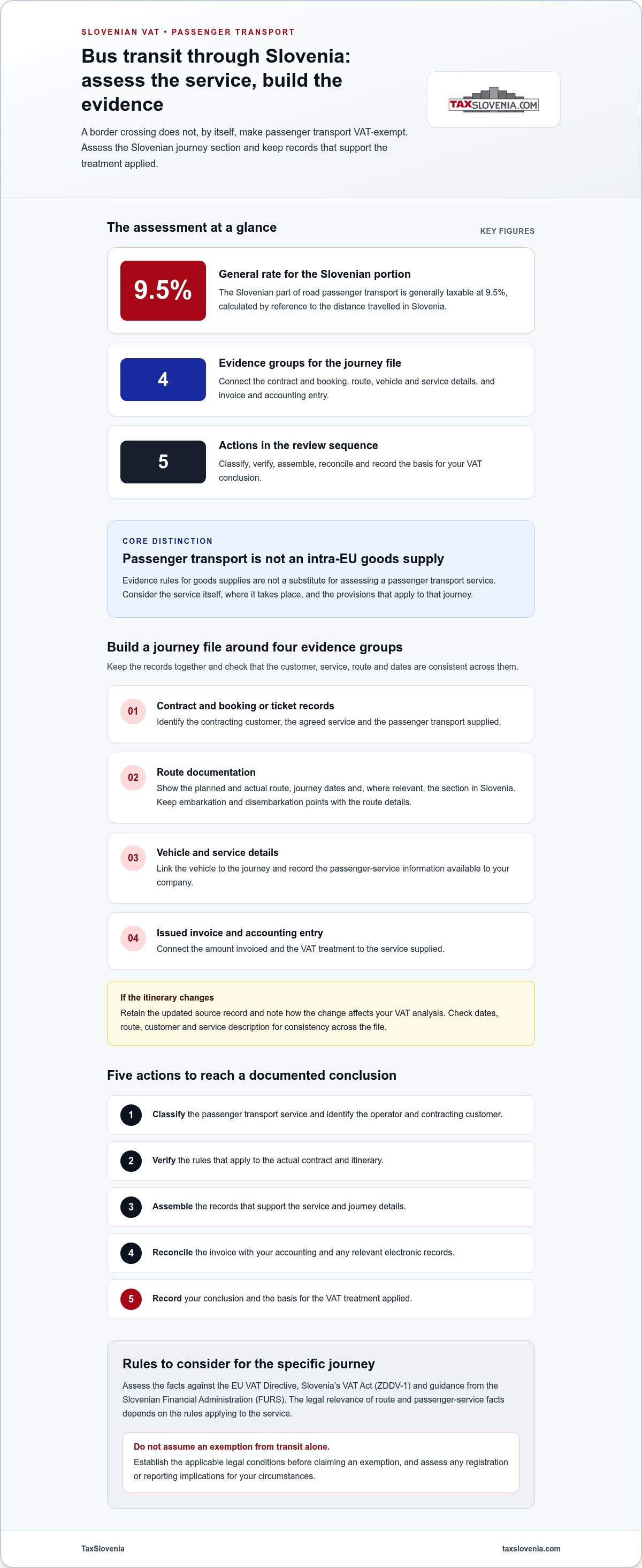
A bus journey through Slovenia is not automatically VAT-exempt, even when the coach is only passing through. For firms from Bavaria, Mehrwertsteuerbefreiung Bus Transit Slowenien Nachweisführung für Firmen aus Bayern starts with a more precise question: which part of the passenger transport takes place in Slovenia, and what records support its VAT treatment? The Slovenian portion of road passenger transport is generally taxable at 9.5%, calculated by reference to the distance travelled in Slovenia.
If your company is based in Bavaria, or elsewhere in Germany, Austria or Switzerland, route details and passenger records need to be considered alongside Slovenian VAT requirements. This article explains how to assess a journey, organise records for each service and coordinate your documentation with Slovenian obligations. TaxSlovenia supports bus companies with Slovenian VAT treatment, registration, special arrangements and documentation.
Key Takeaways
- Assess the passenger transport service itself. A border crossing does not automatically make a journey VAT-exempt.
- Keep evidence for passenger transport separate from records for intra-EU goods supplies. The evidence rules are not interchangeable.
- For Mehrwertsteuerbefreiung Bus Transit Slowenien Nachweisführung für Firmen aus Bayern, organise a journey file that links the contract and invoice to the route, dates, vehicle and passenger-service details.
- Before filing, summarise the route, customer, invoices and available records to assess the Slovenian VAT position and any registration or reporting implications.
Slovenian VAT exemption for bus transit: establish the right tax treatment
A coach crossing Slovenia does not qualify for VAT exemption simply because it is in transit. The key issue is how the passenger transport service is treated for VAT, including the portion of the journey physically carried out in Slovenia. International road passenger transport is not generally exempt just because it crosses a border; the Slovenian portion is generally subject to the 9.5% passenger-transport rate. The phrase Mehrwertsteuerbefreiung Bus Transit Slowenien Nachweisführung für Firmen aus Bayern describes an assessment to make, not an exemption to assume.
Do not use evidence rules for intra-EU goods supplies as a substitute. Those rules concern the movement and supply of goods, whereas a bus operator needs to establish the nature and location of a passenger transport service. The general principles of Value-added tax (VAT) provide background, but the treatment of a particular journey depends on the applicable EU and Slovenian provisions.
Which journey facts determine the Slovenian VAT assessment?
Start with the parties and the service, then map the journey. Record which operator supplies the transport, who the contracting customer is, what service was agreed, the route and the relevant dates. Keep the embarkation and disembarkation points with the route details. These facts can inform the analysis, but their legal relevance depends on the rules applying to the specific service.
For an assessment, consider the EU VAT Directive, Slovenia’s VAT Act (ZDDV-1) and guidance from the Slovenian Financial Administration (FURS). Apply them to the actual contract and itinerary before deciding whether an exemption or another VAT treatment is available. This avoids relying on a goods-supply proof standard or on transit alone to determine the passenger service’s VAT position.
How Bavarian bus companies can organise evidence for Slovenian VAT
A well-organised journey file connects the service you supplied with the VAT treatment in your accounts. Use it as an audit trail, while distinguishing records required by the applicable Slovenian rules from additional documents that help explain your assessment. The phrase Mehrwertsteuerbefreiung Bus Transit Slowenien Nachweisführung für Firmen aus Bayern should prompt a documented review, not an assumption that transit is exempt.
What should the journey file contain?
Bring together records relevant to the particular service and note what each one establishes:
- Contract and booking or ticket records: identify the contracting customer, the agreed service and the passenger transport supplied.
- Route documentation: show the planned and actual route, journey dates and, where relevant, the section in Slovenia.
- Vehicle and service details: link the vehicle to the journey and record the passenger-service information available to your company.
- Issued invoice and accounting entry: connect the amount invoiced and the VAT treatment to the service.
Check that dates, route, customer and service description are consistent across the file. If the itinerary changes, retain the updated source record and note how the change affects your VAT analysis. Keep the file focused on the service and circumstances, rather than treating it as a definitive statutory checklist for every arrangement.
Use the same sequence for each journey: classify the service, verify the applicable rules, assemble the supporting records, reconcile the invoice with your accounting and any relevant strukturierte Aufzeichnungen, then record the conclusion and its basis. Check which electronic records or filing requirements apply to your circumstances. TaxSlovenia provides tailored support for bus-company VAT documentation and can address the Slovenian treatment, registration and relevant special arrangements. Discuss Slovenian bus VAT documentation.
Resolve Slovenian VAT questions before filing or claiming an exemption
Before filing a Slovenian VAT return or applying an exemption, assemble the facts for the specific service. A concise case summary should distinguish the route travelled from the contractual service, identify the party supplying it and show how the invoice reflects your VAT treatment. Resolve Mehrwertsteuerbefreiung Bus Transit Slowenien Nachweisführung für Firmen aus Bayern against the journey and applicable rules, not by assumption.
Your assessment should address the Slovenian VAT position, whether registration or reporting applies, and which records support the conclusion. Where a special arrangement for bus companies is relevant, consider its conditions and consequences alongside the standard treatment. Do not claim an exemption until the applicable legal conditions have been established.
What Bavarian operators should prepare for a Slovenian tax review
Prepare a concise account of how the service was contracted, delivered and invoiced. Include the route and journey dates, the customer and operator, and the records you hold. Identify gaps or inconsistencies clearly, such as a route document that differs from the itinerary used for invoicing.
- A journey summary with the route, dates and passenger-service details.
- The contract, booking or ticket records, route documentation and issued invoice.
- A note of the VAT treatment applied and the basis for it.
- A list of missing, inconsistent or unresolved records.
This preparation allows the service and its supporting evidence to be assessed together. TaxSlovenia supports international businesses with Slovenian VAT matters, including VAT registration and special arrangements for bus companies, with advice tailored to the route and circumstances. Read about Slovenian VAT advice for your bus operations.
Set a clear process for future Slovenian journeys
Set a review point before a Slovenian journey is invoiced or reported. A consistent internal process helps your team flag unusual contracts, subcontracting arrangements or changes to planned services for assessment before they affect VAT reporting. Treat Mehrwertsteuerbefreiung Bus Transit Slowenien Nachweisführung für Firmen aus Bayern as a reason to document your company’s position, not as a tax outcome in itself.
TaxSlovenia can assess the Slovenian VAT position alongside registration considerations and the special arrangement for bus companies, taking account of your operations. For ongoing support, choose a fee structure suited to the work: tax and legal advice can be charged on an hourly or fixed-fee basis, while recurring bookkeeping and payroll services are available for a monthly fee. VAT registration and the setup of special arrangements are project-based services.
Frequently Asked Questions
Is a bus journey automatically VAT-exempt when it passes through Slovenia?
No. A bus crossing Slovenia cannot be treated as exempt solely because the journey is international. The international passenger-transport exemption described in the relevant rules applies to air, sea and rail, not road transport. Before applying an exemption on an invoice, identify the transport mode and establish the legal basis for that treatment under the rules applicable to the service.
Can a Bavarian bus company use its German VAT identification number for Slovenian VAT reporting?
No. A German VAT identification number does not replace a Slovenian VAT identification number where Slovenian registration is required. A Bavarian operator making a taxable supply in Slovenia should assess its Slovenian registration position before carrying out the service. The outcome depends on the company’s activities and the applicable rules, so do not rely on the German number alone for Slovenian reporting.
What happens if a bus route includes passenger pick-ups or drop-offs in several countries?
The contractual and ticketing arrangements matter as well as the itinerary. Establish which company sells or organises the passenger journey and whether another operator only supplies the vehicle and driver. For example, a subcontractor providing the coach may not be the party responsible for the transport service. Identify the supplier and the contractual roles before deciding how the journey should be treated for VAT.
Can a company reclaim Slovenian VAT instead of applying a bus-transport exemption?
A VAT refund and an exemption are separate questions. Recovery of input VAT depends on the expense, the company’s VAT position and the applicable rules. For example, a Slovenian fuel or toll invoice may raise an input-tax question distinct from the VAT treatment of passenger fares. Assess each expense on its own facts; a possible refund does not establish that the transport service is exempt.
Disclaimer
The information provided in this article is for general informational purposes only and does not constitute tax, legal, accounting or other professional advice. Tax treatment may vary depending on the specific facts and circumstances, and legislation and administrative practice may change over time. Before making any decision or taking any action based on this information, we recommend obtaining professional advice tailored to your individual circumstances.


