
Could an Austrian company’s self-disclosure resolve a late Slovenian tax return? Not by itself: Austrian procedures do not automatically correct an obligation handled by FURS, Slovenia’s Financial Administration. For companies in Austria, including those operating from Vienna, and businesses in Germany and Switzerland, the key question behind FURS- slowenisches Finanzamt, Selbstanzeige Slowenien verspätete Steuererklärung Straffreiheit für Firmen in Österreich is whether the right authority and procedure have been identified before action is taken.
It is understandable to want to disclose and pay quickly, but the appropriate next steps depend on the tax involved, what was filed and whether a Slovenian correction or disclosure procedure applies. This guide explains how to identify the relevant authority, what to establish before addressing a late or inaccurate Slovenian return, and which records can clarify your position. It also explains how Slovenian tax and accounting support can help you organise compliant next steps, without promising immunity or a particular outcome.
Key Takeaways
- FURS is Slovenia’s Financial Administration. Identify which authority and rules apply to the specific tax obligation before considering a disclosure.
- An Austrian self-disclosure does not automatically resolve a Slovenian filing issue or guarantee freedom from penalties. The relevant procedure depends on the country and tax obligation involved.
- Before deciding how to correct a late or inaccurate return, establish the entity, tax type, period and filing status. Then gather relevant returns, correspondence, accounting records and payment evidence.
- Slovenian tax advice and accounting support can help you clarify the facts, organise records and plan compliant next steps, without promising a particular outcome.
FURS or the Austrian tax authority? Identify the rules before seeking self-disclosure
An Austrian company can have a filing obligation in Slovenia. The company’s home country alone does not determine which authority handles it. FURS, short for Finančna uprava Republike Slovenije, is Slovenia’s Financial Administration. Its role and structure are outlined by Finančna uprava Republike Slovenije (FURS). Austrian tax authorities administer Austrian tax matters under Austrian rules. The relevant authority depends on the obligation and the jurisdiction to which it belongs.
If a return concerns a Slovenian tax obligation, an Austrian disclosure does not, by itself, correct that Slovenian filing. A cross-border company may need to consider obligations in both countries, but each must be assessed under the rules of the relevant jurisdiction. Identifying FURS is only the first step; it does not establish whether a particular remedy applies.
What does Selbstanzeige mean when a Slovenian filing is late?
In general, a Selbstanzeige is a voluntary disclosure intended to address previously undeclared or incorrectly reported tax matters. Its requirements and possible effects are specific to the legal system involved. The term does not establish that the same process or outcome applies across borders.
In Austria, section 29 of the Finanzstrafgesetz (FinStrG) is the legal reference for self-disclosure in Austrian matters. The Austrian Federal Ministry of Finance (BMF) explains that framework, but it should not be treated as the procedure for a Slovenian FURS filing. Slovenian rules for late or corrected returns must be assessed separately, including any conditions that apply to the tax and the stage of the matter.
FURS and Austrian tax authorities administer distinct tax procedures, so a disclosure made in one country does not automatically resolve a filing obligation in the other. Before submitting a disclosure, correction or payment, establish which authority handles the obligation and assess the applicable Slovenian procedure.
A late Slovenian tax return: a cautious action plan for Austrian companies
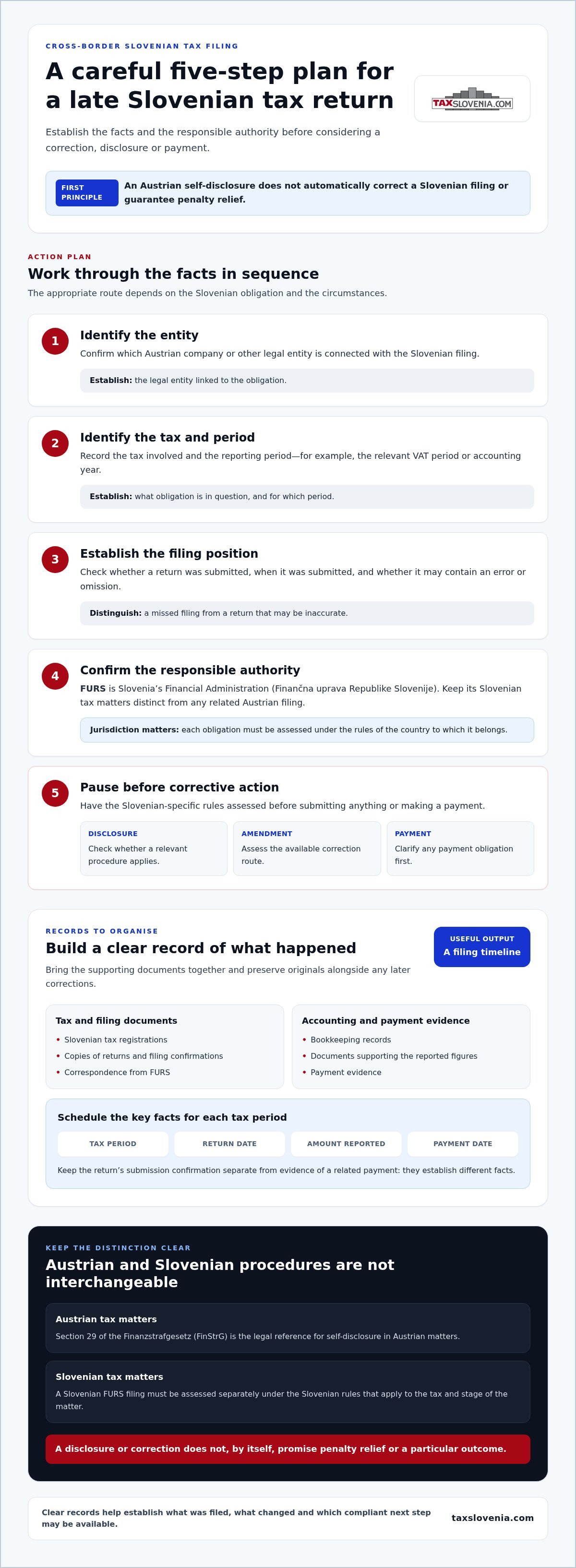
Before deciding whether to file, amend or disclose, establish the facts. A missed filing and an inaccurate return may call for different steps. The right approach depends on the Slovenian tax obligation and the rules that apply to it, so do not assume an Austrian process settles the matter. This applies whether your company is based in Austria or operates across Germany, Austria, Switzerland and Slovenia.
- Identify the entity. Confirm which Austrian company or other legal entity is connected with the Slovenian filing.
- Identify the tax and period. Record the tax involved and the reporting period, such as the relevant VAT period or accounting year.
- Establish the filing position. Check whether a return was submitted, when it was submitted and whether it may contain an error or omission.
- Confirm the authority. Identify whether FURS administers the obligation and keep it distinct from any related Austrian filing.
- Pause before corrective action. Have Slovenian-specific rules on disclosure timing, amendment routes and payment obligations assessed before submitting anything or making a payment.
Which records should you organise before taking action?
Bring together Slovenian tax registrations, copies of returns, bookkeeping records and documents supporting the reported figures. Add correspondence from FURS, filing confirmations and payment evidence. Note the relevant dates and who prepared and submitted each return. If records appear inconsistent, preserve both the original documents and any later corrections so the sequence can be established.
A complete timeline helps show what was filed, what changed and which compliant next step may be available. For example, keep a return’s submission confirmation separate from evidence that a related payment was made: they establish different facts. A simple schedule listing each tax period, return date, amount reported and payment date can make gaps or discrepancies easier to identify.
The phrase FURS- slowenisches Finanzamt, Selbstanzeige Slowenien verspätete Steuererklärung Straffreiheit für Firmen in Österreich should not be read as a promise of penalty relief. The effect of any disclosure or correction depends on the applicable Slovenian rules and the circumstances. If you need help organising the records and assessing the Slovenian filing position, you can discuss your Slovenian filing position with TaxSlovenia.
Resolve a Slovenian filing issue with specialist tax and accounting support
A careful review can help you understand what the Slovenian obligation covers, which reporting periods are affected and how the figures in the accounts relate to the returns submitted. Slovenian tax advice and bookkeeping support can bring those facts together, identify missing or inconsistent records and organise the information needed to consider compliant next steps. TaxSlovenia provides tax and accounting services for companies, including international firms managing Slovenian business obligations. This is a practical way to assess the issue, not a guarantee of immunity or a particular legal outcome.
For companies in Austria, Germany and Switzerland, including businesses based in Vienna, Munich or Düsseldorf, a Slovenian filing issue may need to be considered alongside reporting in the company’s home jurisdiction. The key questions are what is due in Slovenia, what has already been reported and which Slovenian procedure may apply. TaxSlovenia’s specialist review can help distinguish a bookkeeping discrepancy from a filing issue and organise the relevant records for assessment.
What to prepare for an initial assessment
Prepare the company’s Slovenian tax details, the affected reporting periods, copies of submitted returns and any correspondence from FURS. Write a short summary of what appears late or incorrect. Include relevant bookkeeping documents, payment evidence and details of any contact already made with the authority. Clear, dated information helps focus the assessment on the specific obligation rather than assumptions about the remedy.
To discuss your Slovenian tax matter, contact TaxSlovenia with the available records. The information can help clarify the filing position and the appropriate next steps under the applicable Slovenian rules.
Take the next step with a clear Slovenian tax position
Uncertainty can make it tempting to act before the position is clear. A considered next step is to establish what your company needs to address in Slovenia, then rely on advice grounded in the relevant local requirements. Any question about a late return, disclosure or possible penalty relief calls for careful assessment, not assumptions about the result.
TaxSlovenia provides tax and accounting services for companies in Slovenia, including international firms managing Slovenian business obligations. Its support can help you organise the relevant information and build a clearer basis for decisions, without promising a particular legal outcome.
With the relevant facts and Slovenian expertise in view, you can address the issue in a measured and informed way.
Frequently Asked Questions
Can an Austrian company's Selbstanzeige automatically protect it from FURS penalties?
No. An Austrian self-disclosure does not automatically affect a Slovenian tax matter. The relevant procedure depends on the country and tax obligation involved. If the issue concerns a Slovenian return, have its status and applicable Slovenian rules assessed separately before assuming an Austrian filing provides protection.
Can a company correct a Slovenian tax return after submitting it?
Possibly, but the available correction route depends on the type of tax, the error and the procedural stage. For example, an omitted transaction in a submitted return may need a different response from a calculation error that did not change the reported tax. Assess the Slovenian rules for that return before filing a replacement or adjustment, as duplicate or inconsistent submissions can complicate the record.
What should an Austrian company do if FURS has already contacted it?
Read the notice carefully and record when and how it was received, which period and tax it concerns, and whether it specifies a response date. Preserve the original notice and attachments. Avoid sending an incomplete explanation or making a payment based on assumptions. First compare the request with the company’s filed returns, books and payment records, then obtain Slovenian tax advice on the appropriate response.
How much does advice on a late Slovenian tax filing cost?
Fees depend on the work required. Tax and legal advice may be charged hourly or at a fixed fee, while ongoing bookkeeping may use a monthly package. Reviewing one return is different from examining several periods and related accounting records. Describe the tax issue, affected periods and support needed so the proposed fee basis reflects the actual scope.
Disclaimer
The information provided in this article is for general informational purposes only and does not constitute tax, legal, accounting or other professional advice. Tax treatment may vary depending on the specific facts and circumstances, and legislation and administrative practice may change over time. Before making any decision or taking any action based on this information, we recommend obtaining professional advice tailored to your individual circumstances.


