

Could a sickness absence involving an employee working in Slovenia create a dismissal dispute for a business based in Basel, Munich, Vienna or Düsseldorf? The key is to distinguish illness and temporary absence from any separate reason being considered for ending employment. For employers operating across borders, the relevant facts and applicable rules need careful assessment before a decision is made. HR Beratung Arbeitsrecht Slowenien Kündigung bei Krankheit für Betriebe aus Basel can help you organise the questions around the employment relationship.
Establish the legal framework, understand the circumstances behind the absence and assess any proposed termination on its own grounds. This article explains which documents to gather, how to structure your review and how Slovenian HR and employment-law advice can support a considered next step.
Key Takeaways
- Identify which employment rules govern the Slovenian relationship. The employer’s Basel location alone does not settle the question.
- Keep sickness absence records separate from the facts supporting any distinct proposed dismissal ground.
- Review the contract, cross-border working arrangements and relevant records before deciding how to proceed.
- HR Beratung Arbeitsrecht Slowenien Kündigung bei Krankheit für Betriebe aus Basel can help you organise the legal and administrative questions around your specific employment relationship.
Why a Basel Business Must Assess Slovenian Employment Law Before Acting
A period of sickness absence can create operational pressure for employers based in Basel, Munich, Vienna or Düsseldorf who have an employee working in Slovenia. Managing the absence and considering dismissal are separate matters, and each requires a case-specific assessment. The employer’s location in Switzerland, Germany or Austria does not, by itself, establish which employment rules govern the relationship.
Your business location is one relevant fact, but it does not alone determine the legal framework for an employment relationship connected to Slovenia.
What must an employer establish about a Slovenian employment relationship?
Start with the employment documents and actual working arrangements. Identify the legal entity named as employer, where the employee usually works, the contract’s governing-law wording and whether the arrangement involves cross-border work, such as a temporary assignment. An employee hired by one entity but mainly working in Slovenia may raise different questions from someone sent there temporarily. Consider these facts together rather than relying on a single contract clause.
Slovenia’s Employment Relationships Act (ZDR-1) is the principal statute governing employment relationships in Slovenia. For a cross-border contract, the Rome I Regulation may also be relevant to determining applicable law. Its rules for individual employment contracts consider the parties’ choice of law and the employee’s habitual place of work, alongside protections that cannot be set aside by that choice. The outcome depends on the circumstances and contract, so a governing-law clause is not the only consideration.
Before deciding how to manage the absence or assess a proposed dismissal, organise:
- the signed contract and any amendments;
- the employing entity and the employee’s actual work locations;
- documents describing any cross-border arrangement; and
- employment records relevant to the decision under consideration.
A focused HR and employment-law consultation can help employers in Basel, Munich, Vienna and Düsseldorf organise the legal and administrative questions around their Slovenian employment relationship before acting.
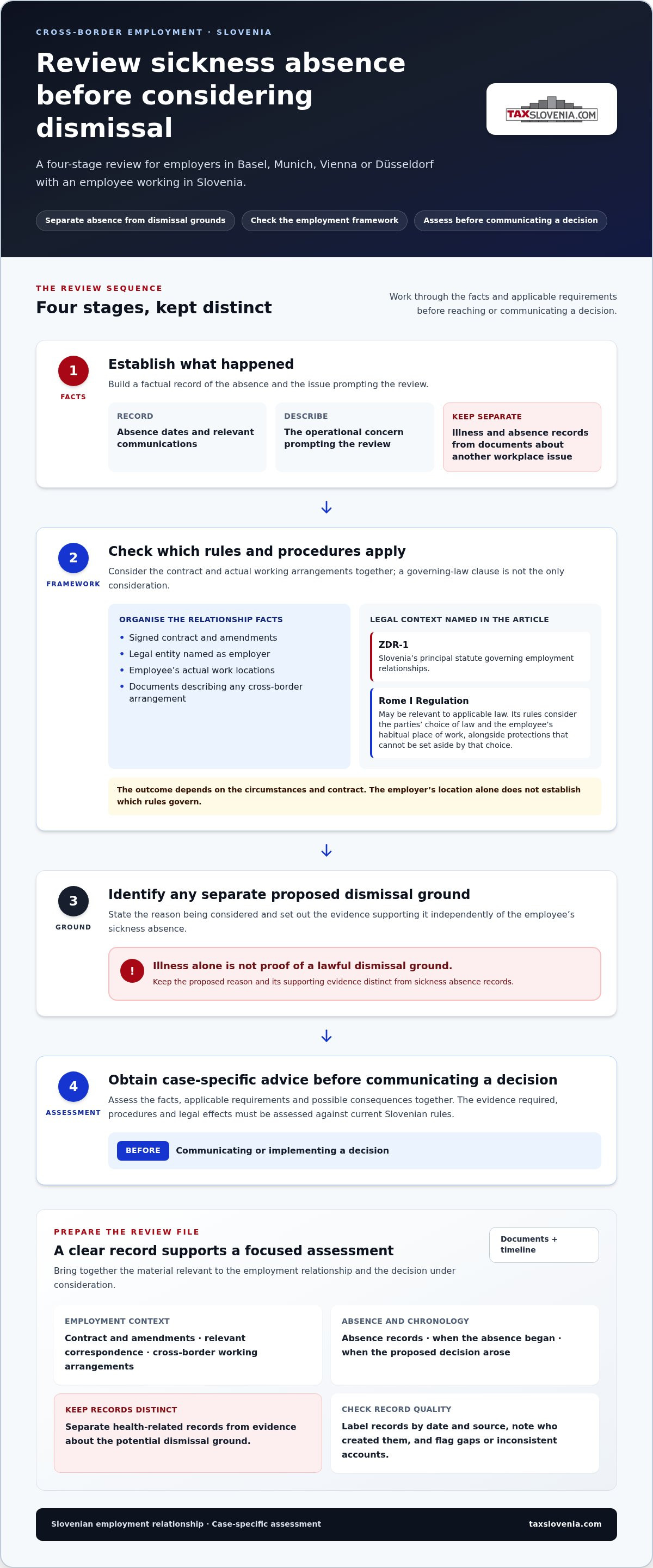
How to Assess Sickness Absence Before Considering Dismissal in Slovenia
If your business is based in Basel, Munich, Vienna or Düsseldorf and employs someone in Slovenia, assess the absence and any proposed dismissal as separate questions. Use the following steps to structure your review. They are not a definitive legal test or a prediction of the outcome.
- Establish the facts. Record the absence dates, relevant communications and the operational concern prompting the review. Keep illness and absence records distinct from documents about any other workplace issue.
- Check the applicable framework. Review the contract and cross-border working arrangements. Establish which rules and procedures apply to this employment relationship before relying on a particular document or process.
- Identify the proposed ground. State the reason being considered and the evidence supporting it, independently of the employee’s sickness absence. Illness alone should not be treated as proof of a lawful dismissal ground.
- Obtain case-specific advice. Assess the facts, applicable requirements and possible consequences together before communicating a decision.
Once you have organised this initial review, discuss your Slovenian employment-law matter to address the questions specific to your cross-border arrangement.
Which facts and documents should the employer organise first?
Prepare the employment contract, relevant correspondence, absence records and a timeline showing when the absence began and when the proposed decision arose. Keep health-related records separate from evidence about the potential dismissal ground. Label records by date and source, note who created them and flag gaps or inconsistent accounts. The evidence required, applicable procedures and legal effects must be assessed against current Slovenian rules.
How can Slovenian HR advice support the employer’s next decision?
TaxSlovenia provides HR and employment-relationship advice for international businesses with Slovenian matters, including employers operating from Basel, Munich, Vienna and Düsseldorf. A focused consultation can help organise the legal and administrative questions around your circumstances. Advisory fees are charged on an hourly or fixed-fee basis. The advice can address the specific employment relationship and decision under consideration.
HR Beratung Arbeitsrecht Slowenien Kündigung bei Krankheit für Betriebe aus Basel
For a business operating from Basel or elsewhere in the DACH region, a practical first step is to turn the available information into a concise decision brief. Set out the issue to resolve, the relevant dates, the documents gathered and any questions about the proposed course of action. This gives the discussion a clear focus and keeps the employee’s illness distinct from any separate employment concern.
TaxSlovenia’s HR and employment-law advice can help you review those questions in the context of the Slovenian employment relationship. Resolve outstanding issues before communicating or implementing a decision, without assuming in advance what the legal outcome should be.
With the relevant facts organised and the right questions addressed, you can proceed with greater clarity.
Frequently Asked Questions
Does a medical certificate issued in Switzerland automatically meet Slovenian requirements?
No. A Swiss-issued medical certificate should not be assumed to satisfy Slovenian requirements automatically. Its relevance depends on the purpose for which it is being used and the rules applicable to the employee’s absence. Before relying on it for absence administration or a later employment decision, establish what evidence current Slovenian procedure requires and whether any formalities apply. The certificate alone does not establish a lawful dismissal ground.
Can an employee in Slovenia return to work gradually after illness?
A gradual return may be possible, but do not assume a particular arrangement is available or sufficient without considering the employee’s circumstances and current Slovenian rules. A proposed reduction in hours or change in duties, for example, raises questions about medical fitness, contractual terms and how the arrangement is recorded. Obtain case-specific Slovenian HR advice before treating a phased return as agreed or as evidence of work capacity.
What documents should a Basel business prepare before seeking Slovenian employment-law advice?
Prepare a dated chronology, identify the decision you are weighing and note which points remain uncertain. Add records showing how the proposed dismissal reason arose, who assessed it and when, keeping these distinct from health-related information. Label documents by date and source, and flag any gaps or inconsistent accounts. This helps an adviser focus on the disputed facts rather than reconstructing the sequence.
How are HR and employment-law advisory fees structured?
TaxSlovenia charges for HR and employment-law advice on an hourly or fixed-fee basis. The appropriate structure depends on the advice required for your matter. Clarify the scope of the work and charging basis before the engagement begins so you can assess how the advice will be delivered.
Disclaimer
The information provided in this article is for general informational purposes only and does not constitute tax, legal, accounting or other professional advice. Tax treatment may vary depending on the specific facts and circumstances, and legislation and administrative practice may change over time. Before making any decision or taking any action based on this information, we recommend obtaining professional advice tailored to your individual circumstances.


